If you are reading this in 2026, you already know that the “green rush” of the early 2020s has been replaced by a much grittier reality. The industry is no longer just about who has the best flower or the flashiest branding. It is about operational stamina.
As someone building across multiple states while rooted in Houston, I have seen the same story play out dozens of times. An entrepreneur wins a license in a new state, tries to carbon copy their existing SOPs, and watches their EBITDA vanish into a black hole of local compliance hiccups and supply chain friction.
Building a Multi-State Operation (MSO) is not just “scaling up” a business. It is managing a collection of independent, highly regulated startups that happen to share a logo. With the federal shift toward Schedule III finally settling in, the game has changed. The tax relief is great, but the compliance bar has never been higher.
If you want to scale without losing your mind (or your shirt), you need to stop thinking like a grower and start thinking like a logistics architect.
The 2026 MSO Landscape: What Changed?
Before we lean into the “how to,” let’s look at the current board. The 2026 market is defined by three major shifts:
| Feature | The Old Way (2022-2024) | The New Reality (2026) |
| Federal Status | Schedule I (Total Prohibition) | Schedule III (Regulated/Medical) |
| Tax Burden | 280E (No deductions allowed) | Normal business deductions (Finally!) |
| Banking | Cash heavy, “gray” accounts | Institutional interest & ACH dominance |
| Competition | Local “Mom & Pop” shops | Well-funded, vertically integrated brands |
While the end of 280E means you actually get to keep your profits, it also means the IRS and the DEA are looking at your books with a magnifying glass. You cannot afford “messy” operations anymore.
The Three Pillars of MSO Sanity
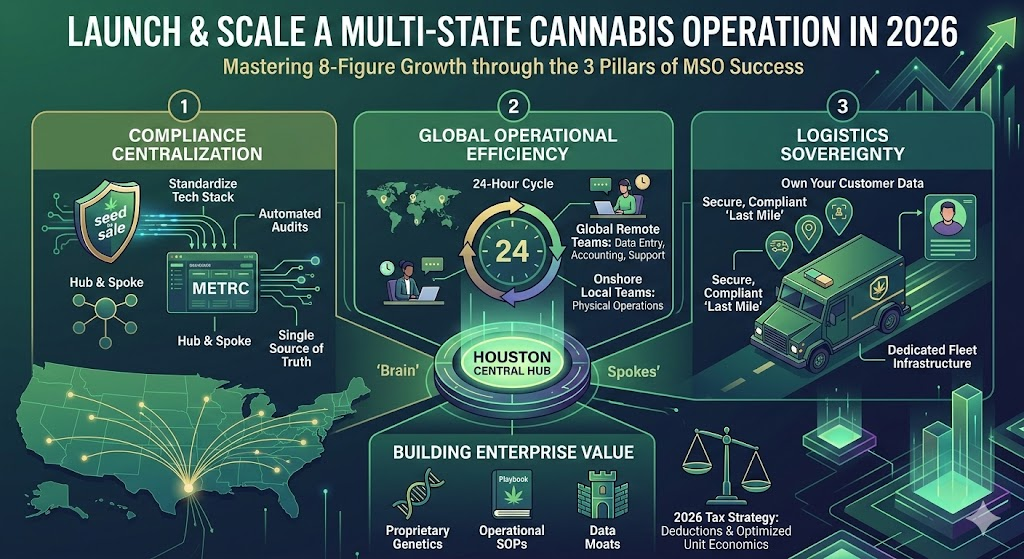
To survive the jump from one state to three (or eight), you have to build your foundation on three non-negotiable pillars: Compliance Centralization, Global Operational Efficiency, and Logistics Sovereignty.
Most founders try to hire a full executive suite in every new state. That is a fast track to bankruptcy. Instead, you need a “Hub and Spoke” model. Your strategy, data, and back office live in the Hub and your physical “plant touching” execution lives in the Spokes.
1. Compliance Centralization
The biggest mistake I see MSOs make is letting every state office “do their own thing” with compliance. California’s METRC requirements are not Oklahoma’s requirements, but the data architecture behind them should be identical.
If your Florida team uses one set of spreadsheets and your Texas THCa team uses another, you will never have a real-time view of your enterprise value. You need a single source of truth. This means:
- Standardizing your tech stack across all markets: Do not let local managers pick their own software. Use one platform that aggregates data into a central dashboard.
- Centralizing financial reporting: You must be able to compare yield per square foot across borders using the exact same metrics.
- Automating your “Seed to Sale” audits: You should not be surprised by a regulatory visit. Your system should flag discrepancies before the state does.
2. Global Operational Efficiency: Scaling with a 24-Hour Cycle
When most cannabis founders think about scaling to an eight-figure operation, they immediately think about hiring more “boots on the ground” in every new market. While you certainly need local talent for cultivation and retail, your back office does not need to be physically located in a high-rent district in Los Angeles or Miami.
To maintain a healthy EBITDA in 2026, you must decouple your growth from the skyrocketing costs of domestic labor for administrative tasks. This is where a global operational model becomes your secret weapon.
What to Offload (And What to Keep)
The key to efficiency is knowing exactly where a remote team can outperform a local one. In 2026, data is the most valuable crop you grow. If your data is messy, your valuation will suffer.
| Task Category | Global Remote Team | Onshore Local Team |
| Data Entry | METRC uploads, inventory logs | Physical plant tagging, harvesting |
| Accounting | Accounts payable, reconciliation | Tax strategy, local audits |
| Customer Support | Wholesale inquiries, D2C chat | In-person sales, brand ambassadors |
| Digital Ops | SEO, social scheduling, web | Dispensary management, logistics |
The “24-Hour” Operational Cycle
By leveraging a global team across different time zones, your MSO never actually sleeps. While your Texas or California team is resting, your remote operations team is cleaning up the day’s data, reconciling sales, and prepping the next morning’s delivery routes.
When your local manager walks into the facility at 8:00 AM, their dashboard is already updated. They are not spending the first three hours of their shift caught up in paperwork. They are focused on the product and the people. This operational flow is how you scale without the typical “burnout” seen in multi-state startups.
3. Logistics Sovereignty
If you rely on third-party platforms to handle your delivery and customer data, you do not own your business. You are just a tenant on someone else’s land. In the 2026 landscape, Logistics Sovereignty means owning the relationship with the end consumer. Whether you are moving wholesale flowers between facilities or delivering D2C, your logistics stack must be airtight.
Why General Delivery Apps Fail Cannabis
- Compliance is baked into the route: You cannot just “drop a package.” Every stop requires ID verification, signature capture, and real-time state reporting.
- Security is a cost center: High-value cargo requires specific protocols that standard apps are not built to handle.
- Data leakage is real: When you use a third-party aggregator, they own your customer list. They can (and will) market your competitor’s products to your loyal buyers.
By building a dedicated infrastructure, you ensure that your “last mile” is as premium as your “first mile.” You are not just selling a product but you are selling a reliable, compliant experience.
Expanding the Blueprint: Strategic & Financial Overlays
Building the foundation is only half the battle. To actually hit those eight-figure milestones, you have to layer on the strategic decisions that separate the “lifestyle brands” from the “market leaders.” This brings us to the next critical phases of the roadmap.
Strategic Integration: Vertical vs. Asset-Light
In 2026, the “Golden Rule” of MSO expansion is that no two states are identical. One of the biggest mistakes you can make is assuming that because a vertically integrated model works for you in one market, it is the only way to win in the next.
The Vertical Integration Trap
Vertical integration, owning the cultivation, the processing, and the retail or D2C delivery, is the holy grail of margin control. It allows you to capture the markup at every stage. However, it is also incredibly capital intensive.
If you try to go fully vertical in a state like California or Florida simultaneously, you might find your cash flow choked by the sheer overhead of maintaining multiple facilities. This is where the “Hybrid MSO” strategy comes into play.
| Strategy | When to Choose It | The Operational Play |
| Full Vertical | High-margin, limited-license states | Own the supply chain from seed to last-mile delivery. |
| White Label | Hyper-competitive, oversupplied markets | Focus on branding and D2C; source premium flowers from existing Tier 1 growers. |
| Logistics Only | Markets with high density, low retail access | Deploy a dedicated delivery fleet to “virtually” expand your reach without more storefronts. |
Building Enterprise Value Through IP
Regardless of whether you grow the plant or source it, your enterprise value in 2026 is tied to your Intellectual Property (IP). Investors are no longer just looking at your harvest weight. They are looking at:
- Proprietary Genetics: Can you produce a consistent profile that competitors cannot replicate?
- Operational SOPs: Do you have a “Playbook” that allows you to stand up a new state operation in under 90 days?
- Data Moats: Do you own the customer journey, from the first click on your site to the final signature at the door?
By using a white label strategy for “trend” products (like minor cannabinoid edibles) while focusing your internal cultivation on “flagship” flowers, you remain agile. You can pivot as consumer tastes change without needing to retool an entire 50,000 square foot facility.
The Financial Reality: Cash Flow and 2026 Tax Strategy
We have to talk about the numbers. For years, the cannabis industry was “fake profitable.” You could show a high gross margin, but after 280E took its cut, your net income was often negative.
With the 2026 tax environment, you finally have the ability to deduct ordinary business expenses. This is a game changer, but it also means you need a higher level of financial sophistication.
Beyond the “Green” Accounting
Your accounting team needs to be obsessed with Unit Economics. You should know exactly what it costs to:
- Produce one gram of dry flower.
- Acquire one new D2C customer via digital channels.
- Deliver one order via your internal fleet.
If you do not have these numbers at your fingertips, you are not running an MSO, but you are running an expensive hobby. Real eight-figure operations are built on the “boring” stuff, optimizing electricity costs in the grow room, reducing driver “deadhead” time on delivery routes, and negotiating bulk pricing on sustainable packaging.
The Founder’s Mindset: Leading Across State Lines
Scaling to an eight-figure operation requires a fundamental shift in how you spend your time. In the beginning, you are the Chief Everything Officer. You are checking the PH levels in the reservoir and you are also the one negotiating with the landlord.
By the time you reach MSO status in 2026, those days have to be over. Your job is no longer to “do” the work. Your job is to design the system that does the work.
The “Remote Leadership” Framework
How do you keep a culture of excellence when your cultivation team is in California, your logistics fleet is in Oklahoma, and your back office is offshore? You lead through Standard Operating Procedures (SOPs) and radical transparency.
- The Weekly Sync: Every Monday, your state leads should report on three numbers: Yield, Cost per Gram, and Customer Retention.
- The Data Buffer: Use your global operations team to handle the daily reporting. This prevents your local managers from “shaving the truth” in their reports. Data does not lie.
- Decentralized Command: Give your local teams the power to make tactical decisions, but keep the strategic levers (like brand identity and capital allocation) at the headquarters.
Strategic Positioning: Why Houston is the “Silent Giant”
People often ask why I lead a multi-state cannabis empire from Houston, Texas. On the surface, it seems counterintuitive. But if you look at the 2026 logistics map, it makes perfect sense.
Texas is the logistical heart of America. By building the “Brain” of my companies in a hub like Houston, I am positioned to move as the legal landscape shifts. Whether it is managing THCa distribution or preparing for the eventual full-scale Texas recreational market, being at the center of the country’s largest shipping and talent corridors is a massive competitive advantage.
The “Future-Proof” MSO Checklist
If you are looking to audit your own operation today, ask yourself these five questions:
- Can we survive a 20% price compression? If your margins are too thin, you need to look at global back office options to cut overhead.
- Do we own our customer data? If you are relying on third-party marketplaces, start building your own delivery infrastructure now.
- Are our SOPs “Plug and Play”? Could you open a facility in a new state next month using your current documentation?
- Is our tax strategy 2026-compliant? Are you maximizing the new Schedule III deductions?
- Is the founder the bottleneck? If the business stops when you go on vacation, you haven’t built an MSO. You have built a job.
The Road to $100M
Building a multi-state cannabis operation is the hardest thing you will ever do. It is a high-stakes game of chess where the rules of the board change every six months. But for those who focus on operational excellence over “green rush” hype, the rewards are generational.
By centralizing your compliance, leveraging global talent, and owning your logistics, you are not just surviving the 2026 market. You are dominating it. Success in this industry is not about who grows the most flowers. It is about who builds the best business.
Got questions? Reach out.