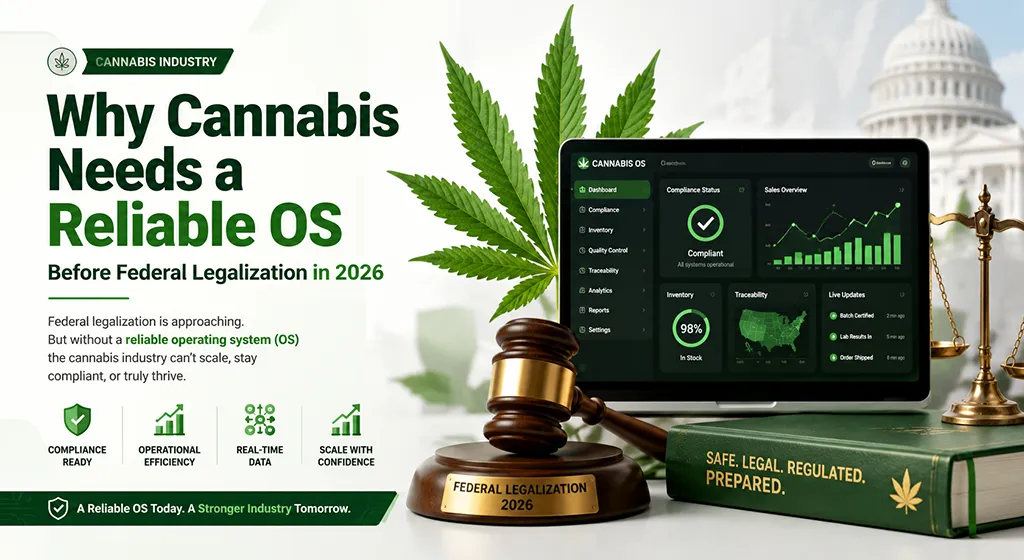
Over the years, I have watched the cannabis industry grow from a fragmented collection of local operators into a high-stakes race for national brand dominance. Many founders believe that federal legalization will solve our problems, but I strongly feel that it will actually expose our deep systemic weaknesses. Without a robust Cannabis OS to manage the complexity of supply chains, most current businesses will soon crumble under the weight of institutional competition.
This blog reflects my thoughts, exploring why we must build digital infrastructure now and how this shift will protect your venture from future market disruption. It also further provides a strategic roadmap for operators to achieve institutional-grade scale through standardized, data-driven backend systems before the big players arrive. Stay scrolling!
Key Takeaways
- Infrastructure First: A robust Cannabis OS is the only way to survive the entry of massive institutional players during federal legalization.
- Data Dominance: Standardizing your digital systems today ensures that your venture is ready for the audits and integration required by global partners.
- Logistical Excellence: Investing in advanced logistics and inventory technology creates a competitive moat that protects your margins and ensures consistent product quality.
- Strategic Partnerships: Building a connected ecosystem through shared digital tools reduces market volatility and fosters long-term B2B growth and market stability.
- Institutional Readiness: Professionalizing your backend systems today prepares your company for the rigors of public markets and federal regulatory oversight in the future.
Establishing the Foundation with a Cannabis OS
Most cannabis entrepreneurs are currently operating their multi-state businesses using tools that are fundamentally not fit for purpose. We rely on disjointed software and manual processes, while the traditional pharmaceutical and alcohol industries are already utilizing advanced enterprise resource planning.
I believe that the successful implementation of a Cannabis OS is the only way to bridge the gap between amateur and institutional. When we finally reach the tipping point of federal legalization, the companies with the most organized data will be the ultimate winners.
An operating system provides the necessary language for different departments to communicate without the friction that usually slows down a rapidly growing startup. By standardizing our internal processes today, we are effectively building a fortress that can withstand the inevitable arrival of massive global corporations.
Surviving Institutional Competition Using a Cannabis OS
I am convinced that the “Wild West” era of cannabis is ending, and the era of the sophisticated infrastructure operator is beginning. When federal barriers drop, companies like Amazon and FedEx will enter the space with logistics capabilities that far exceed anything we currently have.
We must have our systems locked down so that we can integrate with their global networks without losing our identity or margins.
- Standardization allows us to replicate our success in new states without having to reinvent the wheel every single time we expand.
- Data integrity ensures that our financial records are ready for the rigorous audits required by major stock exchanges and institutional banking partners.
- Automated compliance reduces the risk of human error, which is the leading cause of license forfeiture in the most highly regulated markets.
- Efficiency in the back office translates directly to higher EBITDA, which is the only metric that truly matters to high-level venture investors.
Architecting A Resilient Cannabis Ecosystem Via Cannabis Os
I believe that the next decade of this industry will be defined by the strength of the partnerships we build within our cannabis ecosystem. No company can exist as an island when the supply chain becomes global, so we must build systems that facilitate seamless B2B collaboration.
I am architecting a framework where cultivators, processors, and retailers are all connected through a shared digital language that ensures quality and transparency. This level of integration protects the entire industry from the volatility that comes with sudden shifts in federal policy or localized market crashes.
Scaling Your Cannabis Distribution Network Through Cannabis Os
I often tell my partners that a brand is only as strong as its ability to actually get products onto the retail shelves. Building a national cannabis distribution network requires an intimate understanding of logistics that goes far beyond simply owning a fleet of delivery vans.
We must use technology to optimize every route and ensure that our products are stored in the perfect environmental conditions. When we control the distribution intelligence, we effectively control the gate to the consumer, which is the most valuable position in the market.
- Optimized routing reduces the cost per mile, which is essential for maintaining healthy profit margins as the price of wholesale flowers drops.
- Real-time tracking provides our retail partners with the confidence that their orders will arrive exactly when they are needed for the weekend rush.
- Integrated logistics allow us to move inventory between states with different regulatory requirements without slowing down the overall pace of our business.
- Strategic warehousing ensures that we have the right products in the right locations to meet the specific demands of diverse local consumer bases.
Standardizing Trade With A Cannabis B2b Marketplace And Cannabis Os
I have spent years facing the friction of wholesale trading, where buyers and sellers still rely on fragmented text messages and phone calls. I believe that a centralized cannabis B2B marketplace is the only logical solution for a professionalized industry that demands transparency and verified data.
By moving our transactions into a digital environment, we can ensure that every deal is compliant and that all lab results are verified. This shift eliminates the “middleman tax” that often eats into the profits of both the cultivator and the final retail dispensary.
Capitalizing On Cannabis Industry Trends 2026 With Cannabis Os
When I look at the cannabis industry trends 2026, I see a clear move toward consolidation and the rise of massive multi-state infrastructure. I feel that the companies that will survive this consolidation are the ones that have invested heavily in their own internal operating systems.
We are moving away from hype-driven branding and toward a market that values consistency, reliability, and institutional-grade financial reporting across the board. I am positioning my organization to lead this trend by providing the systems that other companies will eventually need to survive.
Connecting A Cannabis Wholesale Network To The Cannabis Os
I have dedicated a large portion of my career to building a cannabis wholesale network that spans across the most important markets. I believe that these relationships are the lifeblood of our business, but they must be supported by a professional digital platform.
The strength of a cannabis wholesale network is directly tied to the reliability of the data that flows between the many different participants. I am working to ensure that our digital systems can integrate with the systems of our partners to create a unified market.
This collaborative approach reduces the friction of trade and allows everyone in the network to grow their businesses much faster than before. I believe that by building the digital infrastructure for the network, we are creating a rising tide that lifts all boats.
Protecting Assets With Cannabis Backend Systems And Cannabis Os
I am convinced that the real value of a cannabis company lies in the quality and reliability of its cannabis backend systems. These are the invisible structures that handle the taxes, the payroll, the compliance, and the security of all our proprietary business data.
We use cannabis backend systems to automate our compliance reporting, which saves our team hundreds of hours of manual labor every single month. And these automations are the only way to maintain a multi-state footprint without significantly increasing our administrative overhead costs.
By investing in our backend today, we are ensuring that we can scale our business efficiently as the market continues to expand. I am proud of the invisible systems we have built because I know they are the foundation of our future success.
Final Thoughts
I have shared my vision for why we must implement a Cannabis OS before the doors of federal legalization finally swing wide open. I believe that by embracing a cannabis SaaS platform and architecting a professional cannabis ecosystem, we are setting the stage for institutional success. Our focus on the cannabis distribution network and the cannabis B2B marketplace is what will allow us to dominate the market in 2026.
By following the cannabis industry trends 2026, we are ensuring that our infrastructure is ready for the challenges and opportunities of the new era. We are not just building a company; we are building the future of the entire cannabis industry through strategic data and intelligence.
Frequently Asked Questions
Q1: What are the primary benefits of implementing a Cannabis OS for a multi-state operator right now?
A: Yes, an operating system provides a unified source of truth that connects every department, from cultivation to retail. It allows for standardized processes, automated compliance, and real-time data visibility, which are essential for scaling efficiently and attracting high-level institutional investors who demand transparency and professional-grade financial reporting.
Q2: How does a cannabis SaaS platform help small brands compete with larger multi-state operators in 2026?
A: Direct answers start with the fact that these platforms provide small brands with access to the same high-level logistics and inventory tools as the giants. By leveraging these digital systems, smaller operators can optimize their supply chains and maintain higher margins, allowing them to remain competitive without needing a massive administrative team.
Q3: Why is federal legalization considered a potential threat to unorganized cannabis businesses that lack digital systems?
A: I believe that federal legalization will bring in massive CPG companies with highly optimized supply chains that will easily crush inefficient local operators. Businesses that lack a robust digital infrastructure will be unable to match the prices, consistency, and speed of these global players, leading to a rapid loss of market share.
Q4: Can a cannabis B2B marketplace help in reducing the high taxes and overhead costs currently plaguing the industry?
A: Yes, by centralizing wholesale trade, a digital marketplace reduces the need for expensive sales teams and simplifies the procurement process for dispensaries. This efficiency helps to lower the overall cost of doing business, which can help offset some of the financial pressure caused by the 280E tax regulations.
Q5: What role does cannabis logistics technology play in ensuring the safety and quality of products for the end consumer?
A: We use advanced logistics tech to monitor environmental conditions and provide a transparent, immutable record of a product’s journey from the farm to the shelf. This ensures that every item meets strict quality standards and that any potential issues can be identified and resolved before the product reaches the customer.