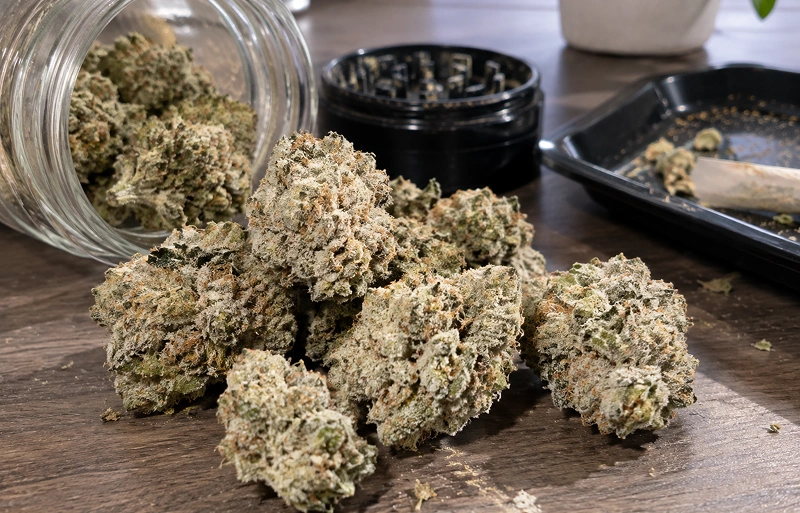
Walk into any store selling hemp, and the coolest jar sitting on the shelf will be marked snowballs. This is a cannabis flower that has been coated entirely in THCA until they look like they have been dusted with snow. Snowballs rank at the very top when it comes to high-quality products. I have worked on the manufacturing and distribution side of this business for many years now, and I can tell you with certainty that there is one product that always leaves people confused. Here is a straightforward look at what snowball weed actually is, how strong it gets, what real buyers report, and where to buy THCA snowballs without getting burned.
What Are THCA Snowballs?
THCA snowballs are flower buds dipped in THCA isolate or THCA diamonds, which make the buds appear frosted or dusted with snow. The basis for making these snowballs is high-quality flowers. The coating consists of 98 to 99 percent THCA concentrate, thus making the final product contain much more THCA compared to the original flower.
Pure THCA is not intoxicating. It becomes delta-9 THC once it undergoes the decarboxylation process, which occurs when a bud is burned. The percentage of THCA printed on the packaging is basically the same as the percentage of delta-9 THC felt by a consumer.
There may be other names for THCA snowballs, such as snow caps, diamond-dusted flower, THCA diamond snowballs, or frosted nugs. The difference in terminology depends only on the producer, while the way of manufacturing is the same for all products. The main components remain the same too: a flower bud and a coat of a concentrate.
How Are THCA Snowballs Made?
THCA snowball creation consists of four stages: select the flower, mist it, coat it, and cure it.
- Select the flower. First of all, you need dense flowers that have been cured correctly and tested for high levels of THCA. If loose flowers are used, the coating cannot be applied evenly, so the bud density is very important in this format.
- Mist the flower. Reputable vendors use distilled water, a terpene mixture, or solventless spray. The main purpose of this step is to facilitate coating application.
- Coating the flower. The flower is covered in powdered THCA isolate or pulverized diamonds. Some vendors apply an additional layer of THCA oil before covering the flower with THCA isolate, thus achieving more than 80 percent content of the active compound.
- The curing of the flower. This process removes surface moisture and fixes the coating on the flower.
If the last step is not performed, the result will be clumpy, burning unevenly, and shedding the coating inside the bag. Everything in my production experience says this is the stage most often rushed.
THCA Snowballs vs. Moonrocks vs. Snow Caps: What’s the Difference?
The difference comes down to the coating material. Snowballs use dry THCA isolate or diamond dust. Moonrocks use sticky oil or distillate combined with kief. Both sit inside the wider infused flower category, but they are not interchangeable.
| Format | Core | Coating | Typical Potency | Flavor Profile |
| Snowballs | Flower | THCA isolate / diamonds | 50-70%+ | Strain-forward; coating is nearly flavorless |
| Moonrocks | Flower | Distillate + kief | ~50% | Heavier; oil and kief dominate the strain |
| Snow caps | Flower | Lighter isolate dusting | 40-60% | Similar to snowballs, slightly milder |
| Snow rocks | Flower | Kief or distillate | 20-30% | Closest to a regular flower |
| Hashrocks | Hash | Kief | Varies | Hash-forward, earthy |
That’s the entire difference that makes everything possible. Due to the fact that THCA isolate is dried and almost tasteless, snowballs allow the terpenes of the original strain to show up. In comparison, moonrocks have the taste of the oil from which they were made. Moreover, snowballs are much less sticky than other infused flower products and easier to use, but they tend to break into pieces.
How Potent Are THCA Snowballs?
THCA snowballs test anywhere between 40 and 70 percent THCA, with high-end samples bragging even more, and the outlier products touting up to 81 percent.
In comparison, potent, raw flower should fall between 20 and 30 percent. A mid-range snowball will have twice the potency of a good, ordinary flower. And a heavily-coated snowball may even reach three times its strength.
Here is what you need to know about the THCA snowballs on the market – all these percentages are simply vendor marketing data until there is a Certificate of Analysis to back up those claims for that specific batch. The range between 30 and 81 percent is too great to be attributed solely to different product characteristics. There is some inconsistency with lab testing and some optimistic labeling involved, which is why my background on the cultivation side makes me read every number twice.
And lastly, potency may differ even from one bud to another within the same jar because the process of coating is performed manually at most businesses. The label is just the estimated value for the batch, not for a specific nug.
Which Strains Are Used for THCA Snowballs?
It is nearly universal practice to begin with dense buds with high resin content, because airy or loose flowers cannot be coated consistently, regardless of the amount of isolate used.
Some of the most frequently mentioned names include Frumpz, Zkittlez, LA Kush Cake, Gary Payton, Kush Mintz, Green Crack, Blue Dream, Sour Diesel, Pineapple OG, Mendo Purps, and Rainbow Chip. The lineup is skewed towards indica and hybrid varieties, both due to bud structure and the strong body high characteristic of the format, much like the Hashburger strain profile.
The importance of proper strain selection is even higher than one may think when purchasing snowballs. As THCA isolate itself does not have any smell or flavor profile, the only thing one is going to taste is the terpenes present in the base flower. If it is grown properly, the product will feature a strain-specific taste. Otherwise, it will not taste like anything, which is the very reason why some customers report a chemical-like experience.
Do not take strain names too seriously. Hemp products’ naming convention is not strictly regulated, and the same name may correspond to different genetics produced by different manufacturers.
What Effects Do THCA Snowballs Produce?
Get ready for a quick, powerful effect: immediate euphoria within five to ten minutes, followed by intense body relaxation that lasts significantly longer than the typical flower.
The typical pattern described by users is a stimulating, talkative head high which then fades into full-body relaxation over 30 to 45 minutes, closer to a sativa like Super Silver Haze at the start than at the finish. The most accurate analogy is that a bowl of 50 percent snowball works the same as two to three bowls of regular high-strength flower.
It’s precisely this reason why you should not use snowball if you are new to cannabis products. Side effects can include dry mouth, increased heart rate, coughing, and even anxiety/paranoia if you take too much relative to your tolerance level. Take only one small inhalation and wait 15 minutes before taking another.
One other important detail that’s frequently overlooked in product descriptions: when heated, THCA has the exact same chemical structure as delta-9 THC and will register in any standard drug test the same way as cannabis.
How Do You Smoke THCA Snowballs Properly?
Either a glass pipe, bong, or dab rig, and then you want to take your nug and break it by hand instead of grinding it.
The number one error in all of this is the use of a grinder. The metal blades remove the isolate layer from the bud and fill the most powerful part of your weed in the grinder’s thread. Breaking your nug by hand and dumping the powder directly in the bowl saves your investment.
Joints and blunts are possible options, but not the best ones. There is a risk of burning the concentrate coating irregularly, getting canoe, and dirtying the paper. Most professionals tend to mix snowballs with regular weed on a 50/50 basis, which results in an even burn and a much better use of expensive concentrates.
As for dabs, don’t go beyond 450 to 550°F, as it will scorch terpenes, resulting in a nasty resinous flavor mentioned repeatedly in negative reviews.
THCA Snowballs Reviews: What Buyers Actually Report
Aggregate reviews in retailer review sections and third-party sites are actually mixed, and both should be read carefully.
What customers like
Overall, established retailers receive scores between 4.4 and 4.7 out of 5 on average with hundreds of reviews. Overall customer comments revolve around potency, longevity, price per gram for larger orders, and efficiency with mixing.
What customers don’t like
Customer complaints are equally consistent and can be divided into four groups:
- Harshness. Most customers experience constant coughing and harsh throat burn that exceeds the effect of regular flower.
- Bad taste. Often described as similar to the flavor of pipe resin when the bowl is lit too much.
- Melting. One of the common complaints about summer deliveries is that the coating becomes softer in transit.
- Disputes over size and potency. The most serious complaint for buyers. Some buyers have complained about getting a couple of small buds instead of a larger order, and potency being lower than the percentage claimed.
How Can You Spot Low-Quality or Fake Snowballs?
Check the Certificate of Analysis first, and if the seller cannot produce a batch-specific one, walk away.
Start with the lab report
A proper COA is specific to your particular batch and goes well beyond just potency. A good COA will include information about cannabinoid levels, pesticides, heavy metals, residual solvents, and microbials, and will have the name, accreditation, and date of testing listed by the lab. Just seeing a generic PDF that applies to all products on the website means absolutely nothing.
Next is the product itself
- Texture: A pure THCA isolate coating is dry and crystallized, not oily or powdery, like chalk.
- Odor: A quality snowball should still retain the scent of its base strain and not have any artificial or chemical odor.
- Base bud: The base bud needs to be dense and cured correctly, not dry and brown or obviously shake-covered in coating.
- Price: Coated buds are expensive to make. If the price is too low, it’s probably a weak base bud or fake coating.
Are THCA Snowballs Legal in 2026?
The honest answer is that federal legality is ending, and the date matters.
Federal law
In 2018, the Farm Bill defined hemp only via its percentage of delta-9 THC (0.3%), which is the loophole that THCA products are based on. In the Continuing Appropriations Act, 2026, passed in November 2025, the federal definition changes to total THC, where THCA is counted as total THC at a conversion factor of 0.877, and total THC must be below 0.4mg for each container of product. The naturally derived cannabinoids become subject to this definition as of December 11, 2026, according to industry estimations, making 95% of all hemp cannabinoid products illegal under federal law.
State law
There is more movement from state laws as well. Texas has been pursuing total-THC regulation via DSHS, which was actively litigated throughout 2026, along with a strict 21+ ID check. California has banned inhalable hemp from being sold through the hemp retail channel since January 2026, in its AB 8. Check your state before ordering, and follow the rule changes as they land through my ongoing coverage.
How Much Do THCA Snowballs Cost?
Prices range between $35-$50 for 3.5 grams, $80-$140 for 7 to 14 grams, and $180-$250 for an entire ounce.
This means that on a per-gram basis, the prices work out to about $10-$14 for smaller sizes and $6-$9 for ounces. This means that the discount for larger quantities is greater for this type than for most others. Smalls (coated popcorn buds) sell 20-30% lower than the quoted price.
The premium is warranted simply because you are paying for two separate goods. One is the base flower, which needs to be grown and cured up to a very high quality, and the other is the coating, which is a pure concentrate and expensive to manufacture. Producers who run on cash flow discipline rarely price below that floor for long. This is why a very low-priced listing is not always a good deal since it indicates either poor base flower or just a filler coating in place of isolates.
Where to Buy THCA Snowballs
Source vertically integrated companies that have the ability to trace back to the origin of the flower and the coating agent used.
This is the subcategory where provenance counts most since the snowball has two components. You will be getting a product of flower and extract quality, and even a single point of vulnerability in the chain of custody will be visible in the jar. Companies that cultivate, process, and distribute from one place can answer those questions, which is why the best THCA snowballs usually come from operators with vertical integration across the whole chain. Brokers who source and resell unknown bulk goods rarely can.
Before purchasing, make sure that:
- There is a batch-specific COA from an accredited lab.
- They have their age verification process clearly stated.
- Their list of states they will not ship to.
- They have a return policy on melted or underweight jars.
If you are a retailer weighing a supplier and want a second opinion on their paperwork, get in touch. Stay away from those marketplaces with no recognizable brand name, no lab testing, and prices far below the market. Here, in this category, the cheapest listing is always the most expensive choice.
Final Thoughts
THCA snowball products are a legitimate product line with sound engineering principles at play, and when done right, they will be true to their label. The issue, however, is that this product line has generated a lot of sloppy production and loose labeling practices, while the frosted effect allows for just about anything to appear luxurious in a photo.
My recommendation is simple. Take a look at the COA, not the picture; take less than you would normally take, avoid grinding your product, and find a source who knows where their product starts and ends. And keep an eye out for the December 2026 federal deadline, because the legal foundation of this entire product line is changing faster than most retailers are letting their clients know. You can follow more of my writing on the cannabis supply chain at Gautham Chidambaram.
FAQs
These are the questions that come up most often about snowballs. For broader questions about my work and the wider cannabis market, see my FAQ page.
1. What are THCA snowballs made of?
These products consist of two parts: a compact, high-THCA flower head and the outer covering consisting of 98% – 99% pure THCA isolate or ground up THCA diamonds. Distilled water or a terpene solution is used to stick the coating onto the flower, after which it remains there for 24 hours.
2. Are THCA snowballs stronger than regular THCA flower?
Yes, substantially. THCA in standard THCA flower ranges from 20 to 30 percent, while that of snowballs is 40 to 70 percent in total. This means a snowball at mid-range is twice the potency of standard flower, and it’s for this reason that users always blend the two.
3. What is the difference between snowballs and moonrocks?
Coating. Snowball is covered with dry THCA isolate or diamond dust that is essentially flavorless and gives a chance to taste the strain’s terpenes. As for Moonrock, it is covered with oil or distillate first and then coated with kief to get a stickier mixture with a dominant oil flavor.
4. Will THCA snowballs show up on a drug test?
Yes. When heat is applied, THCA becomes delta-9 THC, which is structurally the same as the THC in cannabis. Standard tests cannot differentiate between the two. If you are tested by your employer or in the courts, snowballs should be treated like cannabis.
5. Can you put THCA snowballs in a joint?
You can, but it is not the best method. The concentrate coating does not burn evenly; instead, it canoes on the paper. The best equipment for smoking concentrates is a glass pipe, a bong, or a dab rig. For joint fans, start by mixing the snowball 50/50 with flower.
6. Why should you not grind THCA snowballs?
Grinding removes the isolate layer from the bud, confining the strongest elements within the grinder. Since the layer is the reason why the buds cost extra, by manually breaking the nug and pouring the resulting powder into the bowl, one preserves more of it.
7. How long do THCA snowballs last in storage?
About six to twelve months if stored correctly. Store them in an airtight container in a cool, dry, and dark place, preferably at 60-70°F. Excess heat will melt the isolate coating, causing the cannabinoids to degrade, whereas excess moisture will cause the coating to clump and flake off.
8. Are THCA snowballs legal?
Federal-wise, this is being changed. Section 781 of the Continuing Appropriations Act, 2026, substitutes the delta-9 standard for the total-THC standard effective on December 11, 2026, for naturally sourced cannabinoids, making high THCA flower not part of the legal definition of hemp. State laws differ greatly and are being changed, too.
9. Are THCA snowballs suitable for beginners?
Usually not. With 40% to 70% THCA, even one puff can be too much for a beginner to handle, and going past their limit causes anxiety, a fast heartbeat, and uncomfortable feelings for hours. However, if you want to give them a try, combine a little bit with normal weed instead of smoking it.