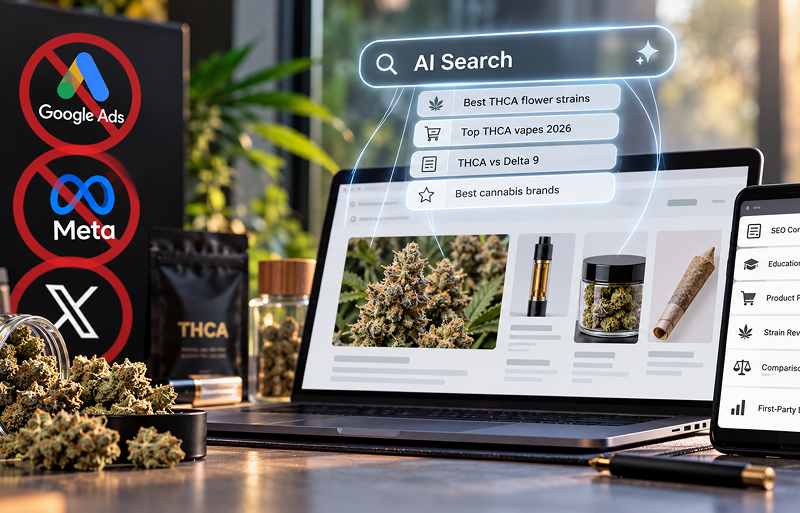
Cannabis marketing has always been complicated. Cannabis companies are not able to advertise their products on Google, Meta, and TikTok due to regulations. Still, there are many people who are interested in cannabis products and search for them every day. Artificial intelligence can help in such cases. In this guide, we will tell you everything about AI cannabis marketing, the importance of automation in establishing long-term relationships with your customers, and how cannabis companies can grow legally.
What Is AI Cannabis Marketing?
AI cannabis marketing is the application of artificial intelligence to get to know your customers, personalize your messages, and automate marketing campaigns in your owned channels. Rather than making assumptions about what your shoppers need, you leverage the power of data to make accurate predictions.
Practically speaking, AI can find correlations that would take a human analyst several weeks to detect. It analyzes purchase history, product preferences, frequency of visits, and responses to email and text message campaigns. Based on this, you can segment customers, find out which products are likely to appeal to particular shoppers, forecast which customers are about to churn, and even create and test content faster.
This is especially important today. The cannabis industry is competitive, and margins are squeezed in numerous states. Once products start to look identical, the only way for brands to stand out is to know more about their customers. Thanks to AI marketing for cannabis, even small teams can access this level of customer insight.
Why Is Cannabis Marketing So Difficult?
Cannabis marketing is challenging because the industry faces advertising bans, state regulations, and taxation all at once. In contrast to other industries, cannabis brands cannot simply buy their way to visibility. They must earn it.
The first issue is paid advertising. Google, Meta, and TikTok do not allow most cannabis advertisements in the United States, with limited exceptions for certain hemp-derived topicals. As a result, the fastest growth channel is closed to cannabis companies.
The second issue is regulation. Each state regulates its own cannabis marketing, prohibiting content that could appeal to children, banning health claims, and requiring age verification. What is legal in one state can be illegal in another, which makes compliance a constant challenge for every multi-state operator.
The third issue is cost. Due to Section 280E of the federal tax code, many cannabis businesses cannot deduct marketing expenses on their taxes, so each dollar must work harder. Together, these barriers push cannabis brands toward owned channels, where AI provides the most value.
How Does AI Help You Understand the Cannabis Customer?
AI helps you understand the cannabis customer by analyzing raw purchase and behavioral data and turning it into useful customer profiles. Instead of assuming all shoppers behave the same way, brands can see what type of customers they have and what matters to them.
Cannabis buyers come in many different kinds. Someone seeking consistent relief will act differently from an occasional buyer of edibles, and someone shopping on a budget will behave differently from someone searching for premium flower. Traditional marketing tends to treat these people the same, which makes the messages they receive vague and easy to overlook.
AI distinguishes between these groups based on actual behavior. It shows brands which products customers buy together, how often certain segments repurchase, which price ranges build loyalty, and which customers respond better to education than to promotions. Over time, these insights shape more than marketing. They also guide product selection, pricing, supply chain planning, and demand forecasting.
How AI Marketing for Cannabis Works Without Paid Ads
Without paid ads, AI strengthens the channels a brand already owns. These channels are less expensive, more compliance-friendly, and help build direct connections with the audience.
Email and SMS
Email and text messages are still two of the most reliable ways to reach a cannabis customer. AI determines which person gets which message and when. Since SMS providers strictly limit cannabis-related content, many cannabis businesses use cannabis-specific platforms such as Alpine IQ and Springbig.
Website and Search
An optimized website attracts shoppers who are looking for specific products or information. AI helps identify the latest search trends, plan valuable content, and personalize the experience for site visitors.
Loyalty Programs
Loyalty programs turn one-time purchasers into regular customers. AI monitors the behavior of program members and delivers the right rewards at the right time, such as points reminders or birthday offers.
Every channel provides additional data to analyze, which helps make each future campaign better than the last.
How Can AI Support Cannabis Content and SEO?
AI supports cannabis content marketing and SEO by revealing what customers are searching for and helping brands publish helpful articles faster. Since search engines rank cannabis content while blocking cannabis advertising, organic search is one of the most valuable free channels.
The process begins with research. AI-based tools can find popular questions, related keywords, and topics competitors have overlooked. This makes it possible to create articles based on the actual needs of customers rather than guesswork.
AI tools also speed up outlines, drafts, and optimization. They can suggest headings, simplify complex regulations, and recommend links to internal pages. Nevertheless, AI-generated content must be edited before publication. Search engines favor pages that reflect real experience and expertise, so the best cannabis content combines the convenience of AI with firsthand knowledge and reliable sources.
Cannabis Marketing Automation: Turning Data Into Action
Cannabis marketing automation uses triggers to deliver the right message at each point of the customer journey. Once set up, these workflows run behind the scenes and make communication easier and more consistent.
Here’s how automation works at each stage of the customer journey:
| Customer Stage | Automated Action | Goal |
| New customer | Welcome series with brand story and product guide | Build trust early |
| First purchase | Follow-up message with product education | Improve the experience |
| Repeat buyer | Personalized product recommendations | Increase order value |
| Loyal member | Exclusive rewards and early access | Strengthen loyalty |
| Inactive customer | Win-back offer based on past favorites | Prevent churn |
Timing makes the real difference with automation. A welcome message is far more likely to be opened immediately after someone signs up than several days later. A well-timed reorder reminder feels helpful, not nagging.
Automation also minimizes the risk of human error. Once a compliant template is approved, every message follows the same standard, which is essential for running compliant cannabis operations in a regulated industry.
How Can AI Improve Customer Engagement for Cannabis Brands?
AI increases customer engagement by personalizing every communication. Engagement rises whenever a brand shows that it understands the customer’s preferences.
Personalization is the main advantage. A small team cannot write personalized messages for thousands of customers, but AI can tailor suggestions, content, and deals to each customer’s history, whether they prefer edibles, flower, or pre-rolls.
AI also helps brands step in before customers leave. With AI customer engagement tools, brands can see which customers’ buying behavior is slowing and reach out with a relevant offer before they switch to a competing brand.
Support quality improves as well. AI chatbots can share store hours, product availability, and order status at any time, without increasing staff.
Finally, AI can personalize educational material for every customer based on their knowledge level. New customers receive simple guides, while experienced buyers get more detailed information.
How Do You Keep AI Cannabis Marketing Compliant?
You keep AI cannabis marketing compliant by combining it with well-defined guidelines and human oversight. AI enables rapid content creation, but it does not replace legal judgment.
Before launching any promotional campaign, check it against these basic compliance measures:
- No health claims. Do not state or imply that a product will cure or prevent a disease.
- Age verification. Confirm that recipients and website visitors are 21 or older, or qualify for the state medical program.
- State regulations. Advertising requirements vary from state to state, so review each market separately.
- No appeal to children. Avoid cartoons, childish language, or any elements attractive to minors.
- Customer consent. Send emails and text messages only to customers who have opted in.
- Human review. A member of your team should approve every AI-generated email or text before it goes out.
Beyond avoiding sanctions, compliance demonstrates professionalism. Customers, retailers, and regulators all take notice of brands that consistently follow the rules.
What Mistakes Should Cannabis Brands Avoid With AI Marketing?
The biggest mistake cannabis brands make with AI marketing is assuming it is a fully automatic process that needs no guidance. AI works best when humans set the goals and review its output.
One mistake is publishing AI-generated content without editing it. Such content can contain false information, sound robotic, lack genuine first-hand experience, and fail a compliance review. Another is feeding AI low-quality data. If customer records are fragmented or duplicated, segmentation and recommendations will be wrong, regardless of how sophisticated the platform is.
A third error is over-messaging customers simply because automation makes it easy. Too many emails and texts lead to unsubscribes and mobile carrier complaints.
The fourth mistake is choosing general marketing tools that do not work well for cannabis businesses. These platforms may suspend accounts suddenly or lack age verification options entirely. Choosing cannabis-specific technology, keeping data clean, and keeping a human in the loop prevent most of these problems.
How to Get Started With AI in Your Cannabis Marketing
Getting started does not require a large budget or a data science team. A step-by-step approach works best.
- Structure your customer data. Combine purchase history, loyalty program information, and customer contacts in one place.
- Choose your platform. Pick software designed for the cannabis industry so compliance tools are built in.
- Start with the basics. Launch a welcome series and a win-back campaign first.
- Create a content strategy. Publish educational cannabis content that answers real customer questions to increase search visibility.
- Monitor results. Track open rates, repeat purchases, and customer lifetime value.
- Iterate and improve. Refine your approach based on what the data shows.
Consistency matters most. Brands that treat AI as a continuous process rather than a one-time project grow more steadily. Start small, learn how your customers respond, and build from there.
Final thoughts
Cannabis marketing restrictions will probably persist for years to come, despite any changes in federal policy. Companies waiting for advertising rules to loosen will fall far behind competitors who have already built strong customer connections.
AI offers cannabis companies a practical solution. It helps them understand their customers, deliver personalized experiences, and handle tasks that once required large teams. Combined with strong owned media and solid compliance practices, AI can turn limited visibility into loyal customers.
The most successful cannabis companies will not be the ones that spend the most on ads. They will be the ones who know their customers best. Start with clean data and the right technology, and let AI help your brand grow responsibly. For more insights on building and scaling a cannabis business, visit Gautham Chidambaram.
FAQs
1. What is cannabis marketing?
Cannabis marketing is the promotion of cannabis products and brands to adult customers within the limits of the law. It includes SEO, email, SMS, loyalty programs, content, and events. Because paid advertising is severely limited, cannabis marketing relies mainly on owned media and educational messaging.
2. Can cannabis businesses advertise on Google or Facebook?
Not usually. Google, Meta, and TikTok do not allow most cannabis ads in the U.S., although Meta permits limited ads for certain hemp-derived topical products. This is one of the main reasons cannabis companies rely so heavily on SEO, email marketing, SMS marketing, and loyalty programs.
3. How is AI used in cannabis marketing?
AI is used for customer segmentation, product recommendations, churn prediction, personalized messaging, and faster content creation. By analyzing purchase history and consumer behavior, AI determines which person should receive which message and when. This allows cannabis companies to create relevant experiences without hiring a large marketing team.
4. What is cannabis marketing automation?
Cannabis marketing automation uses software to send messages automatically based on a customer’s behavior or timeline. Examples include welcome emails for new sign-ups, reorder reminders, birthday rewards, and win-back messages for inactive customers. It saves time and keeps communication consistent.
5. Is AI-generated cannabis marketing content compliant?
Not automatically. AI can produce text quickly, but that content may include health claims or wording that violates state law. Every piece of AI-generated content should be reviewed by an experienced team member or compliance professional before it is published.
6. What AI tools do cannabis marketers use?
Cannabis marketers often use industry-specific platforms such as Alpine IQ and Springbig for customer data, loyalty programs, email, and SMS. General-purpose AI assistants are common for research and content writing. Cannabis-specific tools are important because they are built around the industry’s compliance requirements.
7. How does AI improve cannabis customer retention?
AI improves retention by identifying customers whose purchasing habits have slowed and triggering personalized outreach. It can also recognize when loyal customers should be rewarded and recommend products they are likely to enjoy. These small but meaningful actions help keep customers loyal.
8. Can small cannabis businesses afford AI marketing?
Yes. Many AI-enabled marketing platforms offer packages suited to small dispensaries and early-stage brands. Starting with basic automations, such as a welcome series and a win-back campaign, keeps costs manageable. As results improve, businesses can expand their use of AI gradually.
9. Does SEO work for cannabis brands?
Yes. SEO is one of the most effective ways for cannabis businesses to be found online. Even though search engines block cannabis advertising, they still rank websites that publish helpful, informative content. Optimized pages and useful articles can bring in steady, free traffic over time.