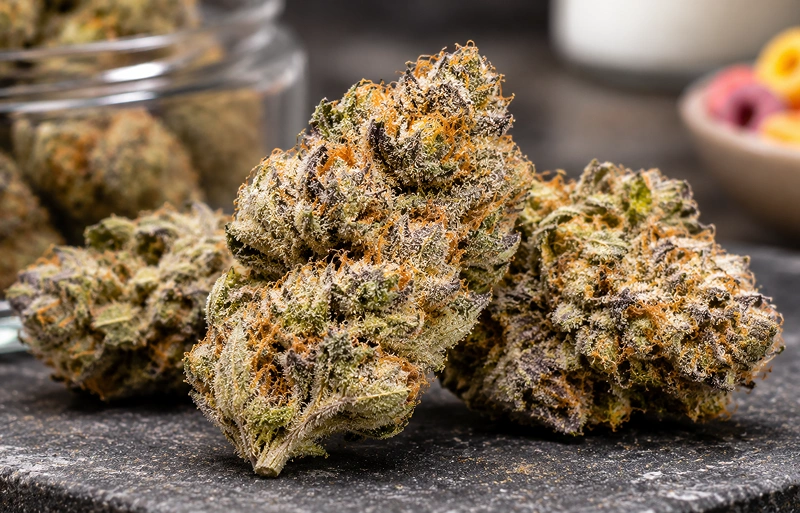
Last November, I turned down 15 pounds of “Cereal Milk” that looked perfect and smelled like nothing. Since 2018, working across cultivation in California and Oklahoma and THCA distribution in Texas, I have learned firsthand that the name printed on the bag means very little to me. In this Cereal Milk strain review, I share what real Cereal Milk smells and feels like, its genetics and effects, my own batch’s lab results, and the test I use to spot impostors.
Cereal Milk Strain Genetics: Pay for the Cut, Not the Name
On paper, Cereal Milk strain genetics are simple. Breeder and strain listings describe it as a cross of Y Life and Snowman, two parents known for frost and sweetness. What matters more is how you use that lineage when you buy.
Each parent leaves a fingerprint you can check in the jar. Y Life, from Girl Scout Cookies and Cherry Pie, should bring dough and a faint berry. Snowman should bring heavy frost and a clean, sharp finish. If a jar labeled Cereal Milk smells only of generic sweetness, with no berry and no frost, I question the genetics before I question my nose.
Popular names get borrowed. In the Austin and Dallas markets, I see mislabeled Cereal Milk every week. Last month, I visited a shop selling “Cereal Milk” that looked completely purple and smelled purely of artificial grape. It was clearly a Purple Punch cross in disguise. True Cereal Milk is light green and frosty, not dark purple.
Is Cereal Milk Indica or Sativa? Read the Lab Report Instead
Cereal Milk is sold as a balanced hybrid, roughly 50% indica and 50% sativa. That label is accurate, but to me it is the least useful fact on the jar.
Indica and sativa started as botanical terms for plant shape. In retail, they became a quick way to sort menus. Large-scale lab testing of commercial cannabis suggests these labels line up poorly with a batch’s chemistry, and chemistry is what changes from jar to jar.
That is why I read the terpene profile on the lab report. Cereal Milk usually leads with limonene, caryophyllene, and linalool. Many experienced consumers associate limonene-forward batches with a brighter feel and caryophyllene-forward ones with a calmer feel. Treat that as a possible pattern, not a rule. Clinical evidence linking specific terpenes to specific effects is still limited, and dose, tolerance, and setting matter as much.
My practical answer: expect a middle-ground hybrid, read the lab report, and trust your own notes over the label.
Aroma and Flavor: The Frosted Cereal Benchmark
The first time I got a true cut of Cereal Milk, I opened the jar, and it smelled like the bottom of a bowl of frosted cereal. That is the benchmark I use for every batch. You want sweet cream and toasted cereal right away, without pushing your nose into the jar.
The buds should be light green and heavily frosted, almost sugar-dusted. Dull flowers, or anything leaning dark purple, deserve a much closer look before you buy.
On a dry pull, a true cut tastes like vanilla frosting. A grassy or hay-like taste is a warning sign. It often points to rushed drying or curing, though harvest timing, storage conditions, and age can cause it too.
Once lit, the inhale should be sweet, milky, and smooth. The exhale is where it really gets interesting: toasted dough with a faint strawberry finish. If the smoke turns harsh early, something likely went wrong between harvest and the jar you are holding.
Cereal Milk Strain Effects: How It Actually Hit Me
Most reviews list the same Cereal Milk strain effects: euphoria, relaxation, creativity. Here is how it actually played out for me the first time I tried a true cut.
- Onset: It hit right behind the eyes first. The opening was uplifting and talkative, the kind of high that makes conversation easy.
- Around 30 minutes: It melted down into my shoulders and back. I felt relaxed but not glued to the couch.
- Peak and fade: The peak lasted roughly 90 minutes and faded out cleanly, with no heavy crash or grogginess.
- Your experience may differ: Dose, tolerance, and setting all play a part.
- Freshness counts: Storage studies show THC slowly degrades while CBN builds up, faster with light and warmth, so an older batch can feel flatter. Check the test date before judging the strain.
- Side effects: Dry mouth and dry eyes are common. With potency often above 20%, newer consumers may feel anxious, so start low and give it time.
The 15 Pounds of “Cereal Milk” I Turned Down
Last November, a broker out of Oregon sent me a video of 15 pounds of what he called indoor Cereal Milk. The bag appeal was incredible, almost entirely white with frost. He wanted $1,400 a pound, which was a steal for true A-grade Cereal Milk.
When the sample box arrived, I cracked the seal and did the jar test. Nothing. No cream, no dough, just a faint, grassy chlorophyll smell. I broke a bud open and got faint lemon and pine. It looked like a million bucks but smelled like a rushed, generic sativa cross.
I rejected all 15 pounds. The broker later admitted it was a White Widow cross that had been mislabeled to move it faster.
If I had bought it on looks and the name alone, my retail clients would never have reordered from me. That deal is why I trust my nose over any photo, video, or price tag, no matter how good the offer looks.
The Cream Test: My 5-Point Cereal Milk Batch Check
I put every Cereal Milk batch through the same five checks. I call it the Cream Test, because the cream note is the first thing to fail when something has gone wrong.
- Aroma integrity. Do the jar test, then snap a bud at the stem. A true cut smells like sweet dough inside. If the stem snap smells like hay, the inside did not cure properly.
- Visual quality. Look for light green, dense but dry buds and intact, cloudy trichomes under a loupe. Spongy texture or smeared trichomes are warning signs worth investigating, not proof of a problem.
- Lab verification. Ask for a batch-specific COA covering potency, terpenes, and contaminants, with the lab name and a recent date.
- Freshness and storage. Check the harvest and test dates, and ask how the flower was stored.
- Consistency. The batch should match what the same supplier delivered before.
A batch that passes all five earns its price. Fail two, and I walk away.
My Cereal Milk Batch Notes: What a Real Lab Report Looks Like
Talk is cheap, so here are the numbers from a Cereal Milk batch I handled this fall. It was harvested on October 4, 2026, and tested two weeks later by a third-party Texas lab.
| Lab Result | Value |
| THCA | 24.8% |
| Delta-9 THC | 0.22% |
| Limonene | 1.15% |
| Caryophyllene | 0.82% |
| Linalool | 0.45% |
| Total terpenes | 3.1% |
| Harvested | October 4, 2026 |
| Tested | October 18, 2026 |
A few things stand out. First, the terpene order matches the classic Cereal Milk profile: limonene leading, with caryophyllene and linalool behind it. When a jar sold as Cereal Milk shows a completely different lineup, I start asking questions about where it came from.
Second, total terpenes matter as much as THCA. This batch carried 3.1% total terpenes alongside its 24.8% THCA, and the jar smelled as loud as the numbers suggest.
Third, the dates are recent and clearly listed on the report. Any serious supplier should be able to show you the same thing.
When you shop, compare your jar’s lab report against this one. The exact figures will vary from grower to grower, but a true Cereal Milk cut should show a similar pattern.
What Retailers Should Know Before Stocking Cereal Milk
Most strain reviews speak only to consumers. Since my work is on the supply side, here is what I would tell a retailer thinking about stocking Cereal Milk.
- The name is both the opportunity and the risk: Customers ask for it by name, so it moves quickly. But a weak batch under a famous name damages trust in your whole shelf, not just in that supplier.
- Ask every supplier for three things: Where the cut came from, a current batch-specific COA, and the harvest date. A supplier who hesitates on any of them is already telling you something important.
- Watch stock rotation closely: The cream note fades with time and handling, so older stock sells worse even when the potency number looks fine.
- Judge it by reorders, not launch week: In my inventory, Cereal Milk turns over about 40% faster than a standard dessert strain like Wedding Cake, and my retail partners reorder it every two weeks without me pushing.
Where Cereal Milk Falls Short
No strain is perfect, and a review that only praises is not worth much. Here is honestly where Cereal Milk falls short.
It is often overpriced, and it is easy to get fooled on price. True A-grade indoor Cereal Milk should cost about $1,600 to $1,800 a pound wholesale, and a premium eighth should run $45 to $55 at retail. If you see an eighth for $25, it is either outdoor, six months old, or not Cereal Milk at all.
The terpene profile is incredibly volatile. This is my biggest frustration with the strain. If a budtender leaves the display jar open for even 10 minutes, that sweet cream smell can evaporate and never come back. It is why I insist on sealed stock.
It is not a specialist strain either. If you want deep sleep, heavy body relief, or a strong, energetic sativa, other strains do those jobs better. Cereal Milk wins on balance and flavor, not on extremes.
Storing Cereal Milk: The Damage Usually Happens Before You Buy
Most storage advice focuses on your home. From the distribution side, I can tell you a lot of the damage happens before the flower ever reaches you.
Display jars are the first problem. A shelf jar opened again and again under warm lights loses its cream note fast. Buy from sealed stock, not the sample sitting on the counter.
Packaging matters too. Thin plastic pouches let aroma escape. Look for glass or sealed packaging with a harvest or test date, and choose the newest you can find.
Light deserves special attention here. Long-term studies of stored cannabis found that light and warmth sped up THC loss, while cool, dark storage slowed it down considerably.
At home, keep it simple: an airtight glass jar sized to your amount, a cool, dark drawer, and a two-way humidity pack around 58 to 62%. Avoid repeated temperature swings, and buy smaller amounts more often. Fresh Cereal Milk beats a large, aging stash every time.
Which Should You Choose? Cereal Milk vs. Strains I Have Reviewed
Rather than repeat strain descriptions, here is how I would steer someone choosing between Cereal Milk and strains I have already reviewed.
If you love Blue Dream but want something richer, Cereal Milk is the upgrade. You trade some brightness for a creamier flavor and a softer landing. Keep Blue Dream for busy mornings.
If Blue Nerds is your favorite, you are already a flavor-first consumer. Cereal Milk swaps candy for cream and finishes more relaxed. I would rotate the two rather than replace one with the other.
If OG Kush feels too heavy for daytime, Cereal Milk is the lighter path. You keep a satisfying body high without the heavy, sedating finish.
If you reach for White Truffle at night, keep it there. Cereal Milk is not a replacement for a true indica-leaning nightcap, and it was never meant to.
My shortcut: pick Cereal Milk when flavor matters most, and you still want to stay involved in your evening.
Why It Earned a Spot in My Rotation
Plenty of strains impress me once. Very few earn a permanent place. Cereal Milk did, for three reasons.
It is honest. When the batch is real, the flavor in the jar is the flavor in the smoke, and the effects match the hybrid label. In a market full of borrowed names, that consistency matters more than an extra point of THC.
It fits my week. My favorite time for it is 4:00 PM on a Friday. It is the perfect transition strain from the workday into the evening, uplifting enough to stay social and relaxed enough to let the week go.
It is easy to verify. Thanks to its distinctive cream note, a jar test and a stem snap tell you most of what you need to know before buying.
It suits flavor-focused consumers and anyone wanting a true middle-ground hybrid. If you want knockout sleep or a racy sativa, look elsewhere. Cereal Milk sits in the middle on purpose.
Final Thoughts
The Cereal Milk strain lives up to its reputation, but only when it is the real thing. Between the 15 pounds I turned down and the batch that tested at 24.8% THCA with 3.1% terpenes, the lesson is the same: trust the jar, not the label.
My advice is simple. Buy from a source that shows you the lineage and a fresh lab report, then run the Cream Test yourself. Real Cereal Milk proves itself within a few minutes.
To learn more about my work across cannabis cultivation, distribution, and technology, visit Gautham Chidambaram. If you are a retailer, grower, or brand looking for premium flower, or you just want to talk strains, reach out anytime through my contact page.
This review reflects personal experience and general strain information. It is not medical advice. Always follow your local laws and consume responsibly.
FAQs
1. Why do two batches of Cereal Milk smell different?
Even with the same genetics, the grower, phenotype, harvest timing, drying, curing, and storage all shape the final aroma. Age matters too, because terpenes fade over time. That is why I judge each batch on its own merits rather than trusting the strain name alone.
2. What should a Cereal Milk lab report (COA) include?
Look for the testing lab’s name, a batch number that matches the package, a recent test date, cannabinoid results including THCA and delta-9 THC, a terpene panel, and contaminant screening for pesticides, heavy metals, microbes, and mycotoxins. Missing sections are worth asking about.
3. Does a higher THC percentage mean better Cereal Milk?
Not necessarily. THC tells you potency, not quality. A batch I handled this fall tested at 24.8% THCA, but its 3.1% total terpenes are what made the jar special. A high-THC batch that smells flat will usually disappoint. Weigh the whole lab report, not one number.
4. Is Cereal Milk the same as Zereal Milk or Cereal Milk Cookies?
No. Several strains share similar names but come from different breeders or crosses. Zereal Milk and Cereal Milk Cookies are separate strains, and some sellers simply borrow the name. Always ask for the lineage so you know exactly which plant you are buying.
5. Can you buy Cereal Milk as a vape or concentrate?
Yes, many brands sell Cereal Milk vapes, rosin, and other concentrates. Quality varies widely. Check whether a vape uses cannabis-derived terpenes or added flavoring, and ask for a COA. Solventless rosin from good flower usually preserves the cream note best.
6. What should I ask a budtender before buying Cereal Milk?
Ask where the cut came from, when the batch was tested, what its top three terpenes are, how long it has been in stock, and whether you can see the full COA. A knowledgeable budtender should answer all five without hesitating.
7. Can Cereal Milk cause anxiety?
It can for some people, mainly at high doses or for those with low tolerance. Its balanced profile makes it gentler than many racy sativas, but potency often exceeds 20%. Start with a small amount, choose a comfortable setting, and wait before having more.
8. What is the best way to enjoy Cereal Milk’s flavor?
A clean glass piece or a dry herb vaporizer at a moderate temperature tends to preserve the cream and vanilla notes better than a hot, harsh burn. Grind just before use, because ground flower loses aroma quickly once exposed to air.
9. Is Cereal Milk worth the premium price?
It is when the batch is real. Expect roughly $1,600 to $1,800 a pound wholesale for A-grade indoor flower, and $45 to $55 for a premium eighth at retail. A $25 eighth is usually outdoor, old, or not Cereal Milk. Let the Cream Test, not the label, decide.